Time Magazine has an excellent article this week about America's food crisis. Here are a few excerpts, but be sure to read the full article here.
"Somewhere in Iowa, a pig is being raised in a confined pen, packed in so tightly with other swine that their curly tails have been chopped off so they won't bite one another. To prevent him from getting sick in such close quarters, he is dosed with antibiotics. The waste produced by the pig and his thousands of pen mates on the factory farm where they live goes into manure lagoons that blanket neighboring communities with air pollution and a stomach-churning stench. He's fed on American corn that was grown with the help of government subsidies and millions of tons of chemical fertilizer. When the pig is slaughtered, at about 5 months of age, he'll become sausage or bacon that will sell cheap, feeding an American addiction to meat that has contributed to an obesity epidemic currently afflicting more than two-thirds of the population. And when the rains come, the excess fertilizer that coaxed so much corn from the ground will be washed into the Mississippi River and down into the Gulf of Mexico, where it will help kill fish for miles and miles around. That's the state of your bacon — circa 2009."
"The U.S. agricultural industry can now produce unlimited quantities of meat and grains at remarkably cheap prices. But it does so at a high cost to the environment, animals and humans. Those hidden prices are the creeping erosion of our fertile farmland, cages for egg-laying chickens so packed that the birds can't even raise their wings and the scary rise of antibiotic-resistant bacteria among farm animals. Add to the price tag the acceleration of global warming — our energy-intensive food system uses 19% of U.S. fossil fuels, more than any other sector of the economy."
"And perhaps worst of all, our food is increasingly bad for us, even dangerous. A series of recalls involving contaminated foods this year — including an outbreak of salmonella from tainted peanuts that killed at least eight people and sickened 600 — has consumers rightly worried about the safety of their meals. A food system — from seed to 7‑Eleven — that generates cheap, filling food at the literal expense of healthier produce is also a principal cause of America's obesity epidemic. At a time when the nation is close to a civil war over health-care reform, obesity adds $147 billion a year to our doctor bills."
"With the exhaustion of the soil, the impact of global warming and the inevitably rising price of oil — which will affect everything from fertilizer to supermarket electricity bills — our industrial style of food production will end sooner or later. As the developing world grows richer, hundreds of millions of people will want to shift to the same calorie-heavy, protein-rich diet that has made Americans so unhealthy — demand for meat and poultry worldwide is set to rise 25% by 2015 — but the earth can no longer deliver. Unless Americans radically rethink the way they grow and consume food, they face a future of eroded farmland, hollowed-out countryside, scarier germs, higher health costs — and bland taste. Sustainable food has an élitist reputation, but each of us depends on the soil, animals and plants — and as every farmer knows, if you don't take care of your land, it can't take care of you."
The full article contains more on the impact of corn subsidies, fertilizers & pesticides, the overuse of antibiotics in CAFOs (Confined Animal Feeding Operations), and the impact to our American farmers. The article also profiles a few farms & businesses (such as Chipotle) that are successfully working to make a difference.
"Organic food continues to cost on average several times more than its conventional counterparts... But not all costs can be measured by a price tag. Once you factor in crop subsidies, ecological damage and what we pay in health-care bills after our fatty, sugary diet makes us sick, conventionally produced food looks a lot pricier."
"What we really need to do is something Americans have never done well, and that's to quit thinking big. We already eat four times as much meat and dairy as the rest of the world, and there's not a nutritionist on the planet who would argue that 24‑oz. steaks and mounds of buttery mashed potatoes are what any person needs to stay alive."
"[W]e have the chance to choose better food three times a day (or more often, if we're particularly hungry). It's true that most of us would prefer not to think too much about where our food comes from or what it's doing to the planet [...] But if there's one difference between industrial agriculture and the emerging alternative, it's that very thing: consciousness."
____________________
Breakfast: cereal & soy milk
Lunch: Chipotle burrito bol, no meat = free guac!
Dinner: General Tso's TVP (Textured Vegetable Protein), very yummy
Showing posts with label Industrialized Farming. Show all posts
Showing posts with label Industrialized Farming. Show all posts
Monday, August 24, 2009


Friday, August 21, 2009
The Dirty Six
In just one hour in the US, more than 1 million animals are killed for food. Before their slaughter, they endure a life of abuse. Considering that nearly 10 billion animals each year are treated as production units rather than social, intelligent animals, this is the gravest animal welfare problem in the country.
The Humane Society of the United States has identified the six worst animal practices in agribusiness:
1. Battery Cages
In the US, 95% of egg-laying hens are confined to battery cages: small wire enclosures stacked several tiers high, extending down long rows, inside windowless warehouses. These cages offer less space per hen than the area of a single piece of paper. The birds are so cramped that they are unable to spread their wings. While many countries are banning these abusive battery cages, the US still overcrowds 300 million hens in these cruel enclosures.
2. Fast Growth of Birds
More than 9 out of 10 land animals killed for human consumption in the US are chickens. About 9 billion are slaughtered each year. The chicken industry's use of growth-promoting antibiotics has produced birds whose bodies struggle to function and are on the verge of structural collapse. (To put their growth rate into perspective, the University of Arkansas reports that if humans grew as fast as today's chickens, we'd weigh 349 pounds by our second birthday.) Ninety percent of chickens have detectable leg problems and structural deformities. More than 25% suffer from chronic pain due to bone disease.
3. Forced Feeding for Foie Gras
French for "fatty liver," the delicacy known as pate de foie gras is produced from the grossly enlarged liver of a duck or goose. Two to three times a day for several weeks, the birds are force-fed enormous quantities of food through a long pipe thrust down their throats to their stomachs. This deliberate overfeeding causes the birds' livers to swell to as much as ten times their normal size. This impairs liver function, expands their abdomens, and makes movements as simple as standing or walking difficult and painful. Several European countries have banned the force-feeding of birds for foie gras.
4. Gestation Crates and Veal Crates
During their 4-month pregnancies, 60-70% of female pigs in the US are kept in gestation crates: individual metal stalls so small and narrow that the animals can't even turn around or move more than one step forward or backward. Similarly, calves raised for veal are confined in restrictive crates, generally chained by the neck, that prohibit them from turning around. This takes an enormous mental and physical toll on the animals. Both of these practices are being phased out in the EU because of their abusive, inhumane nature, but they are still in use in the US.
5. Long-Distance Transport
Billions of animals endure the rigors of transport around the country. Overcrowded onto trucks that do not provide any protection from very hot and very cold weather, animals travel days without food, water, or rest. The conditions are so stressful that in-transit death is considered common.
6. Electric Stunning of Birds
At the slaughter plant, birds are moved off trucks, dumped from transport crates onto conveyors, and hung upside down by their legs in shackles. Their heads pass though electrified baths of water, intended to immobilize them before their throats are slit. From beginning to end, the entire process is filled with pain & suffering. Federal regulations do not require that birds be rendered insensible before they are slaughtered. The shackling of their legs causes pain, increased in those already suffering from leg disorders (see #2) or broken bones. Electric stunning has been found to be ineffective in consistently inducing unconsciousness.
You Can Help
Don't support the cruelties endured by these animals.
-Refine your diet by eliminating the most abusive animal products.
-Reduce your consumption of animal products
-Replace animal products in your diet with vegetarian options
-Only consume animal products that are locally and humanely raised (try your local farmers' market)
____________________
Breakfast: English muffin with jelly
Lunch: Veggie sub from Quizno's
Dinner: Cheeseless pizza loaded with spinach, mushrooms, onion, bell peppers, olives, tomatoes, artichoke hearts, and garlic
The Humane Society of the United States has identified the six worst animal practices in agribusiness:
1. Battery Cages
In the US, 95% of egg-laying hens are confined to battery cages: small wire enclosures stacked several tiers high, extending down long rows, inside windowless warehouses. These cages offer less space per hen than the area of a single piece of paper. The birds are so cramped that they are unable to spread their wings. While many countries are banning these abusive battery cages, the US still overcrowds 300 million hens in these cruel enclosures.
2. Fast Growth of Birds
More than 9 out of 10 land animals killed for human consumption in the US are chickens. About 9 billion are slaughtered each year. The chicken industry's use of growth-promoting antibiotics has produced birds whose bodies struggle to function and are on the verge of structural collapse. (To put their growth rate into perspective, the University of Arkansas reports that if humans grew as fast as today's chickens, we'd weigh 349 pounds by our second birthday.) Ninety percent of chickens have detectable leg problems and structural deformities. More than 25% suffer from chronic pain due to bone disease.
3. Forced Feeding for Foie Gras
French for "fatty liver," the delicacy known as pate de foie gras is produced from the grossly enlarged liver of a duck or goose. Two to three times a day for several weeks, the birds are force-fed enormous quantities of food through a long pipe thrust down their throats to their stomachs. This deliberate overfeeding causes the birds' livers to swell to as much as ten times their normal size. This impairs liver function, expands their abdomens, and makes movements as simple as standing or walking difficult and painful. Several European countries have banned the force-feeding of birds for foie gras.
4. Gestation Crates and Veal Crates
During their 4-month pregnancies, 60-70% of female pigs in the US are kept in gestation crates: individual metal stalls so small and narrow that the animals can't even turn around or move more than one step forward or backward. Similarly, calves raised for veal are confined in restrictive crates, generally chained by the neck, that prohibit them from turning around. This takes an enormous mental and physical toll on the animals. Both of these practices are being phased out in the EU because of their abusive, inhumane nature, but they are still in use in the US.
5. Long-Distance Transport
Billions of animals endure the rigors of transport around the country. Overcrowded onto trucks that do not provide any protection from very hot and very cold weather, animals travel days without food, water, or rest. The conditions are so stressful that in-transit death is considered common.
6. Electric Stunning of Birds
At the slaughter plant, birds are moved off trucks, dumped from transport crates onto conveyors, and hung upside down by their legs in shackles. Their heads pass though electrified baths of water, intended to immobilize them before their throats are slit. From beginning to end, the entire process is filled with pain & suffering. Federal regulations do not require that birds be rendered insensible before they are slaughtered. The shackling of their legs causes pain, increased in those already suffering from leg disorders (see #2) or broken bones. Electric stunning has been found to be ineffective in consistently inducing unconsciousness.
You Can Help
Don't support the cruelties endured by these animals.
-Refine your diet by eliminating the most abusive animal products.
-Reduce your consumption of animal products
-Replace animal products in your diet with vegetarian options
-Only consume animal products that are locally and humanely raised (try your local farmers' market)
____________________
Breakfast: English muffin with jelly
Lunch: Veggie sub from Quizno's
Dinner: Cheeseless pizza loaded with spinach, mushrooms, onion, bell peppers, olives, tomatoes, artichoke hearts, and garlic
Monday, August 3, 2009
Meat's Not Green: Water
Nearly half of the water used in the U.S. is squandered on animal agriculture. Between watering the crops grown to feed farm animals, providing drinking water for billions of animals each year, and cleaning the filthy factory farms, transport trucks, and slaughterhouses, the farmed animal industry places a serious strain on our water supply. According to a special report in Newsweek, “The water that goes into a 1,000-pound steer would float a destroyer.” It takes more than 4,000 gallons of water per day to produce a meat-based diet, but only 300 gallons of water a day are needed to produce a vegetarian diet.
Besides just wasting water, factory farms also pollute it. According to the Environmental Protection Agency, animal factories pollute our waterways more than all other industrial sources combined. The major sources of pollution are from antibiotics and hormones, chemicals from tanneries, fertilizers and pesticides used for feedcrops, sediments from eroded pastures, and animal wastes.
Cows, pigs, chickens, and other animals raised for food produce approximately 130 times as much excrement as the entire human population, except there are no sewage systems to dispose of the waste from factory farms. Much of the millions of pounds of excrement and other bodily waste produced by farmed animals every day in the U.S. is stored in sprawling brown lagoons.
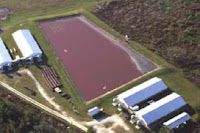
These lagoons often spill over into surrounding waterways and cause massive destruction. In 1995, 25 million gallons of putrid hog urine and feces spilled into a North Carolina river, killing 10-14 million fish. This spill was twice as large in volume as the Exxon-Valdez oil disaster. But, it doesn't take a spill of this magnitude to wreak havoc on the ecosystem. In West Virginia and Maryland, for example, scientists have recently discovered that male fish are growing ovaries, and they suspect that this freakish deformity is the result of factory-farm run-off from drug-laden chicken feces.
Besides the environmental problems caused by farmed animal waste, the dangerous fecal bacteria from farm sewage (including E. coli) can also cause serious illness in humans.
A Scripps Howard synopsis of a Senate Agricultural Committee report on farm pollution issued this warning about animal waste: “...it’s untreated and unsanitary, bubbling with chemicals and diseased... It goes onto the soil and into the water that many people will, ultimately, bathe in and wash their clothes with, and drink. It is poisoning rivers and killing fish and making people sick...Catastrophic cases of pollution, sickness, and death are occurring in areas where livestock operations are concentrated... Every place where the animal factories have located, neighbors have complained of falling sick.”
The EPA reports that chicken, hog, and cattle excrement have polluted 35,000 miles of rivers in 22 states and contaminated groundwater in 17 states yet, amazingly, the federal government continues to allow factory farms to use our rivers as sewers.
____________________
Breakfast: Whole wheat bagel
Lunch: Mango "chicken" (soy chicken subsitute) from Chinese/Thai fusion restaurant
Dinner: Veggie burger
Besides just wasting water, factory farms also pollute it. According to the Environmental Protection Agency, animal factories pollute our waterways more than all other industrial sources combined. The major sources of pollution are from antibiotics and hormones, chemicals from tanneries, fertilizers and pesticides used for feedcrops, sediments from eroded pastures, and animal wastes.
Cows, pigs, chickens, and other animals raised for food produce approximately 130 times as much excrement as the entire human population, except there are no sewage systems to dispose of the waste from factory farms. Much of the millions of pounds of excrement and other bodily waste produced by farmed animals every day in the U.S. is stored in sprawling brown lagoons.
These lagoons often spill over into surrounding waterways and cause massive destruction. In 1995, 25 million gallons of putrid hog urine and feces spilled into a North Carolina river, killing 10-14 million fish. This spill was twice as large in volume as the Exxon-Valdez oil disaster. But, it doesn't take a spill of this magnitude to wreak havoc on the ecosystem. In West Virginia and Maryland, for example, scientists have recently discovered that male fish are growing ovaries, and they suspect that this freakish deformity is the result of factory-farm run-off from drug-laden chicken feces.
Besides the environmental problems caused by farmed animal waste, the dangerous fecal bacteria from farm sewage (including E. coli) can also cause serious illness in humans.
A Scripps Howard synopsis of a Senate Agricultural Committee report on farm pollution issued this warning about animal waste: “...it’s untreated and unsanitary, bubbling with chemicals and diseased... It goes onto the soil and into the water that many people will, ultimately, bathe in and wash their clothes with, and drink. It is poisoning rivers and killing fish and making people sick...Catastrophic cases of pollution, sickness, and death are occurring in areas where livestock operations are concentrated... Every place where the animal factories have located, neighbors have complained of falling sick.”
The EPA reports that chicken, hog, and cattle excrement have polluted 35,000 miles of rivers in 22 states and contaminated groundwater in 17 states yet, amazingly, the federal government continues to allow factory farms to use our rivers as sewers.
____________________
Breakfast: Whole wheat bagel
Lunch: Mango "chicken" (soy chicken subsitute) from Chinese/Thai fusion restaurant
Dinner: Veggie burger
Friday, June 26, 2009
Potatoes
Americans consume more potatoes than any other food behind dairy products and wheat flour. In 1960, the typical american ate 81 lbs of fresh potatoes and 4 lbs of frozen french fries in one year. Today, we eat 49 lbs of fresh potatoes and 30 lbs of frozen french fries per year. 90% of these fries are from fast food restaurants. French Fries are the most widely sold fast food item in the US.
McDonalds switched from fresh to frozen fries in 1965. Customers didn't notice a difference in the taste, and this cut out the labor of peeling and cutting potatoes, making fries one of the most profitable items on the menu (far more than hamburgers). Fast food restaurants purchase frozen french fries at about 30 cents per pound, then sell them for about $6 per pound. Only three companies control 80% of the market for frozen french fries. These three companies compete heavily for fast food chain contracts which, to the benefit fast food chains, lowers their prices, making french fries even more profitable.
Since 1980, the number of potatoes grown in Idaho has nearly doubled. The huge rise in supply has caused significant drops in price, severely affecting potato farmers. Of every $1.50 spent on a large order of fench fries at a fast food restaurant, only about 2 cents goes to the farmer who grew the potatoes. In the past 25 years, Idaho has lost about half of its potato farmers, but the amount of land for potato farms, and number of potatoes produced, has increased. Family farms continue to fold as corporate farms grow and stretch for thousands of acres. Today there are only about 1100 potato farmers left in Idaho - few enough to fit in a high school auditorium.
____________________
Breakfast: English muffin
Lunch: Microwavable pasta bowl
Dinner: An artichoke (my favorite!) & salad
This is a bit more complicated that what I do, but here's some instructions on how to cook and eat an artichoke (I completely skip steps 1-3, I steam it without a steaming basket-just place it in about 1 inch of water, I don't add stuff to the water, and I dip it in melted butter with garlic.)
McDonalds switched from fresh to frozen fries in 1965. Customers didn't notice a difference in the taste, and this cut out the labor of peeling and cutting potatoes, making fries one of the most profitable items on the menu (far more than hamburgers). Fast food restaurants purchase frozen french fries at about 30 cents per pound, then sell them for about $6 per pound. Only three companies control 80% of the market for frozen french fries. These three companies compete heavily for fast food chain contracts which, to the benefit fast food chains, lowers their prices, making french fries even more profitable.
Since 1980, the number of potatoes grown in Idaho has nearly doubled. The huge rise in supply has caused significant drops in price, severely affecting potato farmers. Of every $1.50 spent on a large order of fench fries at a fast food restaurant, only about 2 cents goes to the farmer who grew the potatoes. In the past 25 years, Idaho has lost about half of its potato farmers, but the amount of land for potato farms, and number of potatoes produced, has increased. Family farms continue to fold as corporate farms grow and stretch for thousands of acres. Today there are only about 1100 potato farmers left in Idaho - few enough to fit in a high school auditorium.
____________________
Breakfast: English muffin
Lunch: Microwavable pasta bowl
Dinner: An artichoke (my favorite!) & salad
This is a bit more complicated that what I do, but here's some instructions on how to cook and eat an artichoke (I completely skip steps 1-3, I steam it without a steaming basket-just place it in about 1 inch of water, I don't add stuff to the water, and I dip it in melted butter with garlic.)
Tuesday, June 23, 2009
I Couldn't Have Said It Better Myself
The only son of the founder of the Baskin-Robbins ice cream empire, John Robbins was groomed to follow in his father’s footsteps, but chose to walk away from Baskin-Robbins and the immense wealth it represented to "...pursue the deeper American Dream...the dream of a society at peace with its conscience because it respects and lives in harmony with all life forms. A dream of a society that is truly healthy, practicing a wise and compassionate stewardship of a balanced ecosystem."
John Robbins' many bestsellers include Healthy At 100: The Scientifically Proven Secrets of the World’s Healthiest and Longest-Lived Peoples. Widely recognized as one of the world's leading experts on the dietary link with the environment and health, John’s work has been the subject of cover stories and feature articles throughout the national media. His life and work have also been featured in an hour long PBS special titled Diet For A New America.
John's awards include the Rachel Carson Award, the Albert Schweitzer Humanitarian Award, and the Peace Abbey’s Courage of Conscience Award.
His life is dedicated to creating an environmentally sustainable, spiritually fulfilling and socially just human presence on this planet.
Sunday, June 7, 2009
Home On The Range
Cowboys, ranchers, and farmers are American icons, symbols of freedom, independence, self-reliance, and hard work. But, the American rancher is a disappearing breed. In the past 20 years, over 500,000 ranchers sold off their livestock and quit the business. The remaining 800,000 are struggling to survive. The hard-working ranchers idealized in cowboy legends are likely to go broke today.
We live in a new era, where ranchers and farmers are more often portrayed as ignorant, racist, economic parasites, and despoilers of the land. In 1959, eight of our nation's top ten TV shows were westerns. The networks ran 35 westerns in prime time every week. That American ideal is now a distant past.
Many factors have contributed to the downfall of the American rancher, including the rise of the fast food industry, the lack of government regulations on agribusiness, unethical practices by agribusiness firms, and increasing urban development.
The growth of the fast food industry changed the face of the meat packing industry by encouraging consolidation. In 1968, McDonald's (the nation's largest purchaser of beef) bought its beef from 175 local suppliers. By 1970, seeking to achieve product uniformity, McDonald's reduced its suppliers down to five. In 1970, the top four meat packing firms slaughtered 21% of our cattle, but in the 1980's the Reagan administration allowed the meat packing firms to merge without any antitrust enforcement, and today the top four meat packers (ConAgra, IBP, Excel, and National Beef) slaughter 84% of our cattle. (Farmers are not allowed to slaughter their own cattle, per USDA regulations. Cattle are raised by independent ranchers, then auctioned off to slaughterhouses for processing.)
The four major meat packers control about 20% of the live cattle in the US. When the prices of cattle start to rise, the meat packers can flood the market with their own supplies to drive prices back down. Over the last 20 years, the rancher's share of every retail dollar spent on beef has fallen from $0.63 to $0.46.
Cattle ranchers worry that beef industry is deliberately being restructured along the lines of the poultry industry and they do not want to end up like chicken farmers who are virtually powerless, trapped by debt and unfair contracts to large processors. The poultry industry was also transformed in 1980's by a series of mergers. Only eight chicken processors control about 2/3 of US market.
The idea that agribusiness executives secretly talk on the phone with their competitors to set prices and divide up the market, is not just a conspiracy theory. Three executives from Archer Daniels Midland, a supplier of livestock feed additives, were sent to federal prison in 1999 for precisely this. Over a 3.5 year period, Archer Daniels Midland & their conspirators overcharged farmers as much as $180 million for feed additives through a massive price-fixing scheme.
Unfortunately, ranchers are afraid to testify against large companies for fear of retaliation & economic ruin. In 1996, Mike Callicrate, a cattleman from Kansas, testified before the USDA against the large meat packers, who promptly stopped buying his cattle. Callicrate is now an activist for ranchers, speaking at congressional hearings, and joining class action lawsuits against the large meat packers. Callicrate says that he refuses to "make the transition to slavery quietly."
Ranchers have also fallen victim to the advice of agribusiness firms to give their cattle growth hormones. Cattle are much bigger today, so fewer are sold, and most can not be exported to the European Union where bovine growth hormones have been banned.
In some areas, like Colorado, ranchers face threats unrelated to cattle prices. In the last 20 yrs, Colorado has lost 1.5 million acres of land to development. Between population growth and the growing number of vacation homes, land costs have skyrocketed, making it impossible for ranchers to expand their operations. Plus, inheritance taxes can claim more than half of a cattle ranch's land value. Even if a family manages to operate its ranch profitably, handing it down to the next generation may require selling off large chunks of land, diminishing its productive capacity. The median age of Colorado ranchers is 55. Ranchland in Colorado is now diminishing at the rate of 90,000 acres per year.
As our ranchers' traditional way of life is destroyed, so is their livelihood. The suicide rate among ranchers in the US is three times higher than the national average. Osha Gray Davidson states in his book Broken Heartland, "To fail several generations of relatives... to see yourself as the one weak link in a strong chain... is a terrible, and for some, an unbearable burden."
Our current industrialized food system is not only a nightmare for our animals, our health, and our environment, but it is also destroying our hard-working farmers and the ideals of the American west.
____________________
Brunch: Sopes without cheese or sour cream (or meat, obviously)
 Dinner: Veggie spring rolls, tofu lettuce wraps, veggie pad thai
We live in a new era, where ranchers and farmers are more often portrayed as ignorant, racist, economic parasites, and despoilers of the land. In 1959, eight of our nation's top ten TV shows were westerns. The networks ran 35 westerns in prime time every week. That American ideal is now a distant past.
Many factors have contributed to the downfall of the American rancher, including the rise of the fast food industry, the lack of government regulations on agribusiness, unethical practices by agribusiness firms, and increasing urban development.
The growth of the fast food industry changed the face of the meat packing industry by encouraging consolidation. In 1968, McDonald's (the nation's largest purchaser of beef) bought its beef from 175 local suppliers. By 1970, seeking to achieve product uniformity, McDonald's reduced its suppliers down to five. In 1970, the top four meat packing firms slaughtered 21% of our cattle, but in the 1980's the Reagan administration allowed the meat packing firms to merge without any antitrust enforcement, and today the top four meat packers (ConAgra, IBP, Excel, and National Beef) slaughter 84% of our cattle. (Farmers are not allowed to slaughter their own cattle, per USDA regulations. Cattle are raised by independent ranchers, then auctioned off to slaughterhouses for processing.)
The four major meat packers control about 20% of the live cattle in the US. When the prices of cattle start to rise, the meat packers can flood the market with their own supplies to drive prices back down. Over the last 20 years, the rancher's share of every retail dollar spent on beef has fallen from $0.63 to $0.46.
Cattle ranchers worry that beef industry is deliberately being restructured along the lines of the poultry industry and they do not want to end up like chicken farmers who are virtually powerless, trapped by debt and unfair contracts to large processors. The poultry industry was also transformed in 1980's by a series of mergers. Only eight chicken processors control about 2/3 of US market.
The idea that agribusiness executives secretly talk on the phone with their competitors to set prices and divide up the market, is not just a conspiracy theory. Three executives from Archer Daniels Midland, a supplier of livestock feed additives, were sent to federal prison in 1999 for precisely this. Over a 3.5 year period, Archer Daniels Midland & their conspirators overcharged farmers as much as $180 million for feed additives through a massive price-fixing scheme.
Unfortunately, ranchers are afraid to testify against large companies for fear of retaliation & economic ruin. In 1996, Mike Callicrate, a cattleman from Kansas, testified before the USDA against the large meat packers, who promptly stopped buying his cattle. Callicrate is now an activist for ranchers, speaking at congressional hearings, and joining class action lawsuits against the large meat packers. Callicrate says that he refuses to "make the transition to slavery quietly."
Ranchers have also fallen victim to the advice of agribusiness firms to give their cattle growth hormones. Cattle are much bigger today, so fewer are sold, and most can not be exported to the European Union where bovine growth hormones have been banned.
In some areas, like Colorado, ranchers face threats unrelated to cattle prices. In the last 20 yrs, Colorado has lost 1.5 million acres of land to development. Between population growth and the growing number of vacation homes, land costs have skyrocketed, making it impossible for ranchers to expand their operations. Plus, inheritance taxes can claim more than half of a cattle ranch's land value. Even if a family manages to operate its ranch profitably, handing it down to the next generation may require selling off large chunks of land, diminishing its productive capacity. The median age of Colorado ranchers is 55. Ranchland in Colorado is now diminishing at the rate of 90,000 acres per year.
As our ranchers' traditional way of life is destroyed, so is their livelihood. The suicide rate among ranchers in the US is three times higher than the national average. Osha Gray Davidson states in his book Broken Heartland, "To fail several generations of relatives... to see yourself as the one weak link in a strong chain... is a terrible, and for some, an unbearable burden."
Our current industrialized food system is not only a nightmare for our animals, our health, and our environment, but it is also destroying our hard-working farmers and the ideals of the American west.
____________________
Brunch: Sopes without cheese or sour cream (or meat, obviously)
 Dinner: Veggie spring rolls, tofu lettuce wraps, veggie pad thai
Subscribe to:
Posts (Atom)